

How Can Fish Waste Turn into Energy and Protein?
Fish processing generates large amounts of waste, including heads, bones, skin, and other by-products that are often discarded or used for low-value applications. However, these fish residues still contain valuable energy and nutrients.
At Protein
One of the first steps is a process called anaerobic digestion. During this process, microorganisms break down organic material in the absence of oxygen. As the fish residues decompose, they produce biogas, which contains methane and can be used as a renewable source of energy.
At the same time, nitrogen is released in the form of ammonium. Instead of being lost, this nitrogen can be recovered and used to grow hydrogen-oxidizing bacteria (HOB), microorganisms capable of producing protein-rich biomass.
To grow, these bacteria require:
- hydrogen as an energy source,
- carbon dioxide to build new cells,
- recovered nitrogen for growth.
As they grow, the bacteria produce biomass rich in protein. Unlike conventional protein production, these microorganisms do not require agricultural land or large amounts of water. They can convert simple compounds into valuable proteins, offering new possibilities for sustainable food and feed production.
To scale up this process, several challenges still need to be addressed, including improving biogas production and ammonia recovery, as well as assessing how flue-gas impurities may affect the growth, protein yield, and quality of hydrogen-oxidizing bacteria cultures. Ongoing research is helping to optimize these processes and evaluate their potential for future sustainable protein production systems.
This integrated approach demonstrates how fish-processing residues can be transformed into both renewable energy and new protein sources, supporting more circular and sustainable food systems.
Read more about the study and the current results HERE.
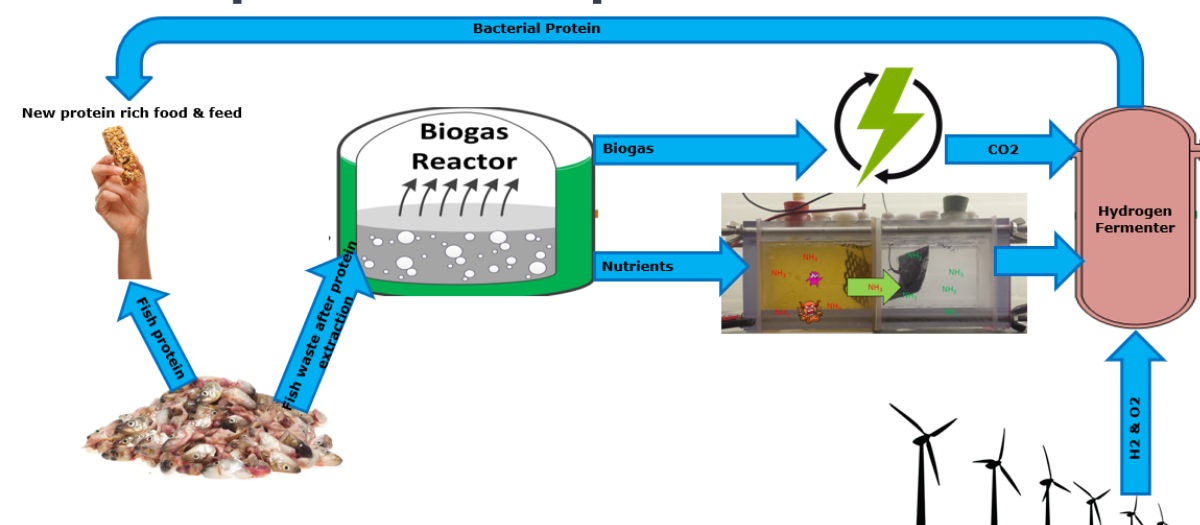
Vizualization of the process.
 This work was funded by the European Union’s Horizon Europe programme as part of project PROTEIN4IMPACT (Grant Agreement No. 101182324). Views and opinions expressed are, however, those of the author(s) only and do not necessarily reflect those of the European Union or the European Research Executive Agency (REA). Neither the European Union nor the granting authority can be held responsible for them.