

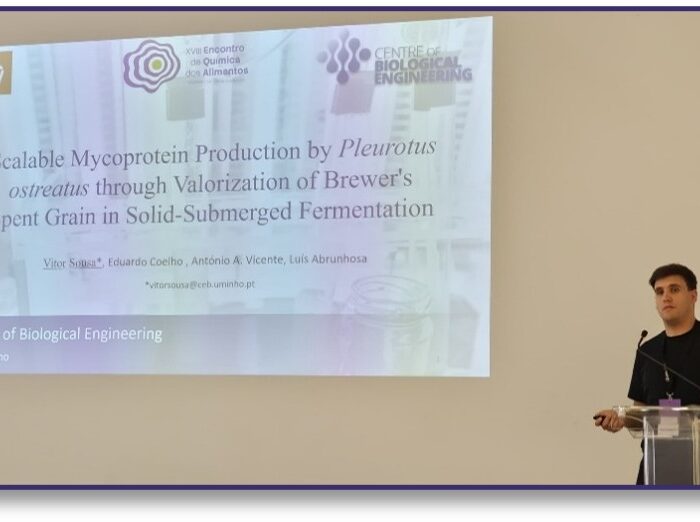
Researchers from PROTEIN
Different bioreactors, different strengths
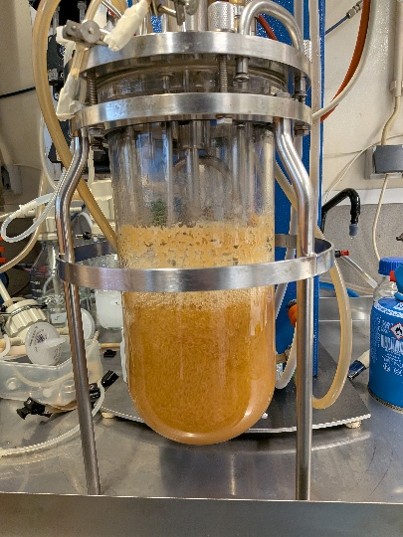
The team then compared a stirred-tank bioreactor with an airlift bioreactor. Both systems achieved higher biomass productivity than flask cultivation, although they performed differently across the measured outcomes. The stirred-tank bioreactor reached a biomass concentration of 30.52 g/L. This measure helps researchers understand how much fungal material a system produces within a given volume.
The airlift bioreactor (below) achieved the highest reported mycoprotein yield, at 12.23 g per 100 g. Mycoprotein yield helps researchers assess how much of the target protein-rich material is obtained relative to a specified amount of material.
To ensure the safety and quality of the produced mycoprotein, the presence of potential mycotoxin contaminants was assessed in the initial by-products – brewer’s spent grain- and in the resulting fungal biomass after fermentation. The aim was to evaluate whether the BSG substrate or the fermentation process influenced the presence or concentration of mycotoxins potentially associated with this agro-industrial by-product. Only Fumonisin B2 was detected in the BSG samples prior to fermentation and after fermentation with P. ostreatus, the concentration of Fumonisin B2 decreased, corresponding to an average reduction of 25 %.

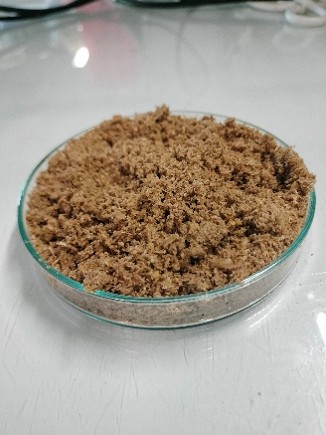
A step towards more efficient production
Using food-industry by-products as cultivation resources offers a way to explore new uses for materials that might otherwise be underutilised. At the same time, developing mycoprotein production requires more than identifying a suitable raw material – researchers also need to understand how cultivation conditions and equipment affect the process.
By comparing bioreactor configurations, this work provides further evidence to guide the development of fungal biomass production. Further research will be needed to assess safety, process performance and the feasibility of larger-scale production.
Read the full abstract HERE.
 This work was funded by the European Union’s Horizon Europe programme as part of project PROTEIN4IMPACT (Grant Agreement No. 101182324). Views and opinions expressed are, however, those of the author(s) only and do not necessarily reflect those of the European Union or the European Research Executive Agency (REA). Neither the European Union nor the granting authority can be held responsible for them.