


The interview was originally published in Revue CentraleSupélec Alumni (Revue n°34 – 3e trimestre 2026). It has been translated into English for the Protein
What is the main objective of the project on agro-industrial residues?
Protein
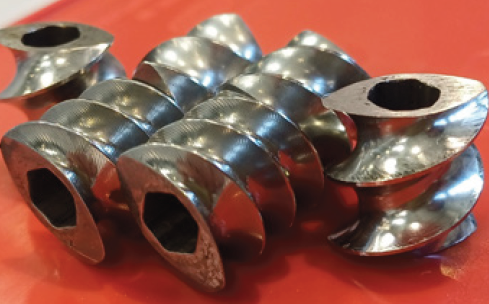
What technological innovations are you developing to transform these residues into food ingredients?
Our team (CS) is working on a reactive extrusion process. During this process, the material – for example, brewer’s spent grain – is shaped and processed simultaneously in an extruder (pictured), through the combined effects of pressure, temperature and mechanical shear.
We have explored different operating conditions by varying the parameters and carrying out numerous experiments, with the aim of exploiting mechanical, thermal and chemical energy to modify and fractionate the biomass. This allows us to obtain protein-rich fractions from residues, particularly brewer’s spent grain.
How can this project inspire new practices in the agricultural and agri-food sectors?
This study is part of a biorefinery approach applied to residues produced in large quantities across Europe – brewer’s spent grain.
Through the processes developed, we have not only succeeded in obtaining new sources of protein, but also in producing bio-based materials from secondary co-products. In this way, the biomass can be further valorised and used to its full potential.
 This work was funded by the European Union’s Horizon Europe programme as part of project PROTEIN4IMPACT (Grant Agreement No. 101182324). Views and opinions expressed are, however, those of the author(s) only and do not necessarily reflect those of the European Union or the European Research Executive Agency (REA). Neither the European Union nor the granting authority can be held responsible for them.